 Client trainingVisited 0 of 32 modules
The monthly close and your scorecard
After this module you know what "closing the books" means and why it matters, what arrives on business day ten, how to read the four pages of the scorecard, and what the first ninety days look like.
Six minutes: the month start to finish, what closes, and what arrives on business day ten.
What closing the books means
A month is not finished when it ends. It is finished when every number in it has been checked against something outside the books and nothing can change it afterward. That is the close. Eight steps, every month:
- Every bank and card account reconciled to the statement, to the cent (Finance 3).
- Inventory counted and the product used moved to cost of services by service line (Operations 3).
- Deferred revenue rolled from the booking system: packages and memberships delivered this month become revenue; the rest stays owed (Finance 2).
- Payroll, commissions and incentives accrued to the month they were earned.
- Depreciation booked on equipment; loan payments split into interest and principal.
- Sales tax reconciled and the figures sent to your CPA.
- Anything odd questioned. A vendor that doubled, a deposit that does not match the booking system, a personal charge on the company card.
- The month locked so nothing dated inside it can drift.
The month, start to finish
- Every dayBank feeds download overnight. Receipts get photographed the day they happen. Benchmark codes the feed two or three times a week so nothing piles up.
- Around the 5thPayroll runs. The provider posts to QuickBooks. Commissions and incentives for the prior month are accrued.
- Business day 1 to 3You send the month end inventory count (Operations 3). We pull the deferred revenue and provider reports from the booking system.
- Business day 3 to 9The close, steps 1 to 8 above.
- Business day 10Your package arrives: the four page scorecard with the read, then the P&L, P&L by month, balance sheet, and reconciliation reports. Read the scorecard first, the P&L second.
- Mid monthA 30 minute call if anything on the scorecard needs a decision. Otherwise questions by email or text, answered within a business day.
- QuarterlySales tax figures to your CPA. The cash forecast and the financial model updated with actuals. Budget against actual reviewed.
- January 151099 vendor list to your CPA. Year end close package follows.
The scorecard: four pages, read in order
The numbers come from the books and the booking system. The read is the advice. Over a year the reads become the operating history of the clinic, and the numbers become the benchmark you measure every new idea against. Every metric on the four pages is defined in Finance 5.
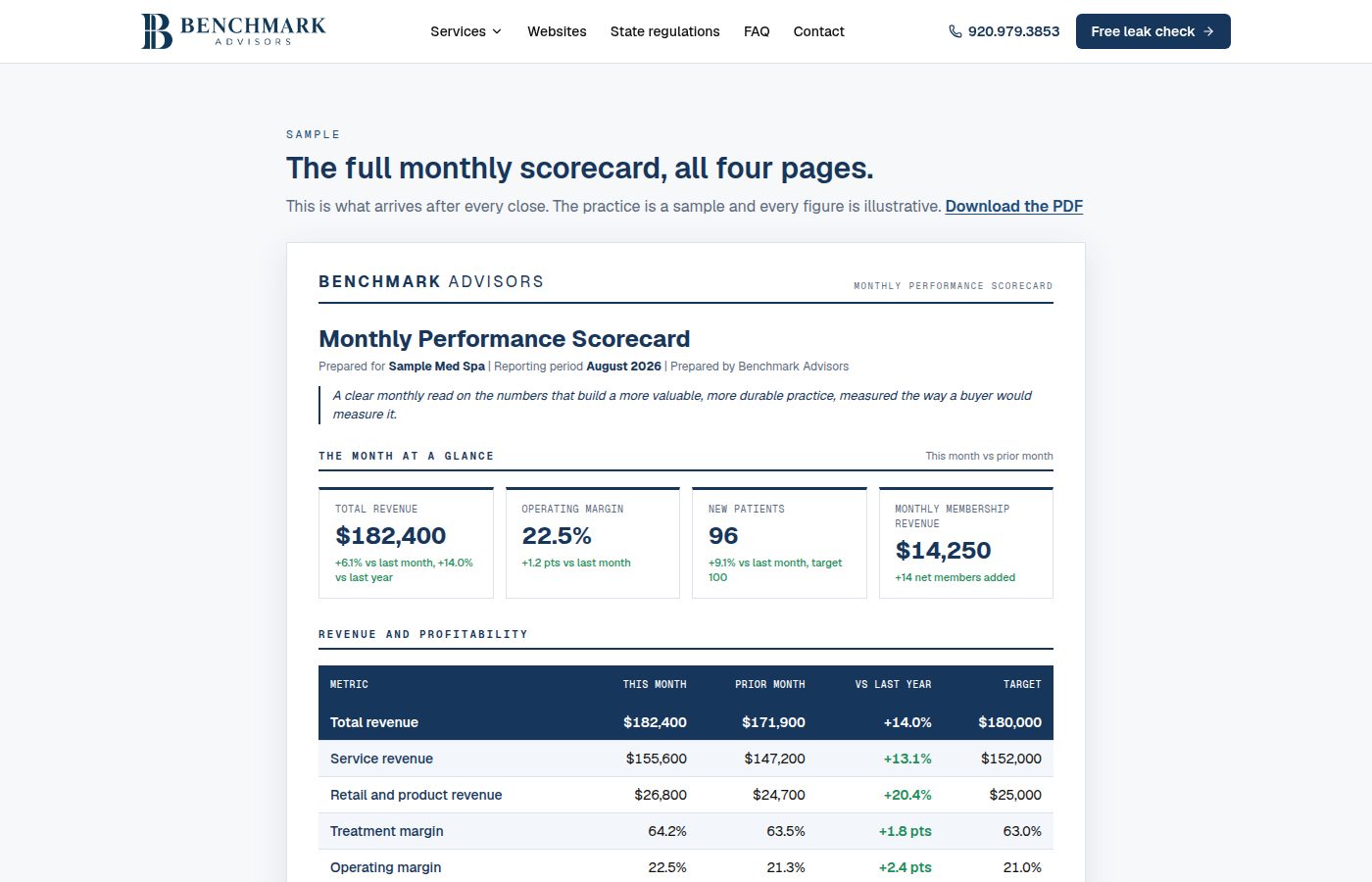
| Page | What is on it | The question it answers |
|---|---|---|
| 1. The month at a glance | Revenue, operating margin, new patients and membership revenue as four tiles. The six numbers to read first. Revenue and margin against last month, last year and target. Revenue by service line with a market read. | Did we make money, and from what? |
| 2. Providers and productivity | Revenue, revenue per hour, rebook and retail attach by provider. Revenue per appointment, appointments per day, room use, minutes per visit, units per patient. | Is the schedule producing, and how much rides on one person? |
| 3. Patients, marketing, reputation | New patients, returning share, rebook, back within 90 days, no-shows, lapsed patients brought back. Leads to consults to treatments, cost per lead, cost per new patient, revenue per marketing dollar. Reviews and rating. | Are patients coming, coming back, and what does each one cost? |
| 4. Membership, add-ons, goals, the read | Members, adds, cancellations, churn, membership revenue, member versus non-member spend. Add-ons and packages. The goals scorecard against the targets we set together. Wins, risks, next moves. | Is the recurring base growing, and what do we do next month? |
The six numbers to read first
Page 1 leads with six numbers because they catch most problems early. Each has a target, this month, last month, and a note that says what to do.
| Number | Why it matters | What good looks like |
|---|---|---|
| Revenue per provider hour | Is the schedule producing? | Depends on your mix; $450 and up for an injector heavy clinic |
| Gross margin on your biggest service | Does pricing cover product? | Neurotoxin around 70% and up |
| Members and monthly churn | Recurring revenue is what buyers pay for | Growing every month, churn under 5% |
| Marketing cost per new patient | Is growth spend earning back? | Under $150 for most clinics |
| Rebook at checkout | Retention starts at the desk | 55% and up for the best desks |
| Cash runway | Months of operating cost in the bank | Three months is the floor we work to |
Where those targets come from: the annual AmSpa State of the Industry report, Boulevard's published revenue data, the M&A advisor reports in Advanced 5, and what we see across clients. The sources page lists each.

The first ninety days with Benchmark
- Month 1Bank feeds connected, rules built as real vendors appear, first inventory count. Expect questions; the first month is where the coding conventions get set.
- Month 2First full close on real numbers. First scorecard with actuals rather than targets. The close training session happens here, on your books.
- Month 3Targets set together from the first two months of baseline. Budget against actual becomes part of the package. From here the rhythm above is steady state.
Try it yourself
Your monthly package arrives. What do you read first?
The balance sheetThe scorecard and its readThe reconciliation reportsA month is "closed" when
The calendar month endsEvery account is reconciled, the adjustments are booked, and the month is lockedThe bank statement arrivesGross margin on neurotoxin fell four points. The first thing to check is
Marketing spendProduct cost per unit and the inventory countRentCash runway means
Total revenue this yearHow many months of operating cost the current cash balance would coverThe loan balanceWhen does the close training on your own books happen?
Before the sprintAfter the first full month of real transactionsAt year end